

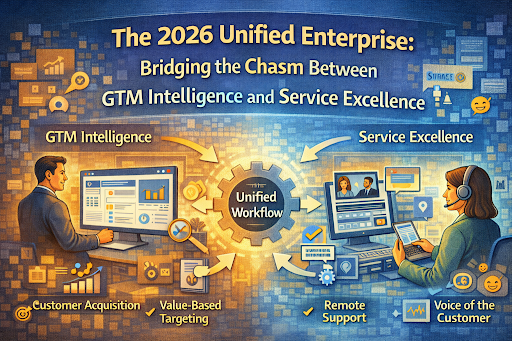
In the current B2B climate, the “handover” is where revenue goes to die. Traditionally, organizations have operated in silos: Marketing generates the lead, Sales closes the deal, and Support handles the aftermath.
This linear model is no longer sufficient. Today’s buyers expect a circular, continuous relationship where the intelligence gathered during the initial pitch informs the service they receive three years later.
To achieve this, enterprises must master two distinct but related disciplines: high-velocity Go-To-Market (GTM) strategies and frictionless technical service delivery. When these two engines are synchronized, the result is a “flywheel” effect that drives exponential growth.
The Anatomy of a High-Performance GTM Strategy
A go-to-market strategy is more than just a launch plan; it is the blueprint for how a company delivers its unique value proposition to the right customers. In 2026, the strategy has shifted from “volume-based” (how many emails can we send?) to “value-based” (how much insight can we provide?).
Advanced Market Segmentation and “Micro-ICPs”
Broad industry categories like “SaaS” or “Manufacturing” are too blunt for modern competition. High-performing GTM teams now use data to create “Micro-ICPs.” For instance, instead of targeting “Financial Services,” a firm might target “Mid-market fintech companies in the EMEA region currently undergoing a cloud migration with a recently appointed CTO.”
This level of granularity is only possible when your GTM strategy is underpinned by real-time intelligence. By identifying these niches, companies can tailor their messaging so precisely that the prospect feels the solution was built specifically for them.
The Role of Intent Data in Timing the Market
Timing is often more important than the message itself. Intent data tracks the digital breadcrumbs left by prospects, such as webinar attendance, whitepaper downloads, or specific searches on third-party review sites.
A modern GTM framework integrates this data directly into the salesperson’s workflow. Instead of guessing who to call, sellers receive “hot triggers.” This proactive approach reduces the sales cycle significantly because the conversation starts at the moment of peak interest.
Sales and Marketing Alignment (Smarketing)
The age-old war between Marketing (who wants leads) and Sales (who wants good leads) must end. A unified GTM strategy creates a shared language. Both teams should be measured on the same North Star metric: Customer Acquisition Cost (CAC) vs. Lifetime Value (LTV). When Marketing is incentivized to find high-LTV customers, the quality of outreach improves, and the Sales team’s closing rate skyrockets.
The Critical Importance of Frictionless Service
Winning the customer is only the first half of the battle. In a subscription-based economy, the real profit is made during the renewal. This is where technical service delivery becomes a revenue-generating function rather than a cost center.
The friction often begins when a customer encounters a technical hurdle. If the support experience is clunky, for example requiring multiple emails, disconnected chat tools, or confusing downloads, the customer’s perception of the brand sours. This is why leading enterprises are integrating tools like ScreenMeet for ServiceNow to create a seamless “one-pane-of-glass” experience.
Eliminating the “Diagnostic Gap”
The most frustrating part of technical support is the “Diagnostic Gap”, the time spent trying to explain a visual problem over a text-based medium. By utilizing integrated remote support and co-browsing within a platform like ServiceNow, agents can bridge this gap instantly.
When an agent can see exactly what the customer sees, they move from “asking” to “solving.” This doesn’t just lower the Average Handle Time (AHT); it builds immense psychological trust. The customer feels seen, understood, and supported.
Security as a Competitive Advantage
In 2026, data privacy is a board-level concern. Many third-party remote desktop tools operate outside the primary IT Service Management (ITSM) ecosystem, creating “shadow IT” risks and data silos.
By using a solution that is native to or deeply integrated with ServiceNow, all session data, chat logs, and recordings are stored within the secure environment the company already trusts. This “In-Platform” approach ensures that SOC2, GDPR, and HIPAA compliance are maintained effortlessly, which is a major selling point for GTM teams targeting enterprise clients.
Empowerment Through Co-Browsing
Modern support is moving away from “I’ll do it for you” toward “I’ll show you how.” Co-browsing allows an agent to guide a customer through a complex UI in real-time. This is particularly effective for “onboarding” (the bridge between GTM and Service). If a customer is successfully educated on how to use the product during their first support interaction, their likelihood of becoming a long-term advocate increases by over 60%.
Turning Support into Sales Intelligence
The true magic happens when the data from the Service side of the house flows back into the GTM strategy. This creates a feedback loop that makes the entire organization smarter.
By adopting a comprehensive Go-To-Market strategy that utilizes deep market intelligence, you ensure your company is always fishing in the right ponds. By supporting those customers with an integrated remote support for ServiceNow platform, you ensure those customers become lifelong partners.
1. Identifying Upsell Triggers
When a support agent is helping a customer and realizes they are trying to perform a task that requires a higher-tier module, that is a prime “expansion” opportunity. If the support tool is integrated with the CRM, a task can be automatically created for the Account Executive. This isn’t “selling”; it’s providing a solution to a documented need.
2. Product Development Guided by Reality
If the GTM team is promising a specific outcome, but the Support team is seeing a recurring bug in that feature, the organization has a problem. By analyzing support session recordings and logs, Product Marketing can adjust the GTM messaging to be more accurate, and Engineering can prioritize the right fixes. This alignment prevents “over-selling” and reduces the “Expectation Gap.”
3. The “Voice of the Customer” (VoC) at Scale
Every support interaction is a focus group. When you use integrated video and screen-sharing tools, you aren’t just getting a ticket number; you are getting a recording of the customer’s actual experience. AI tools can now analyze these recordings to detect sentiment, identifying which parts of the product cause frustration and which cause delight. This “unfiltered” feedback is the most valuable data a GTM strategist can ever have.
Measuring the Impact (The ROI of Convergence)
If you are proposing this unified approach to your C-suite, you need to speak the language of ROI. The convergence of GTM intelligence and frictionless service impacts the bottom line in three measurable ways:
| Metric | Impact of Siloed Teams | Impact of Unified Teams |
| CAC (Customer Acquisition Cost) | High (Wasteful outreach) | Low (Data-driven targeting) |
| NRR (Net Revenue Retention) | Low (High churn due to friction) | High (Proactive support & expansion) |
| Agent Productivity | Low (Toggling between 5+ apps) | High (All tools inside ServiceNow) |
| Brand Sentiment | Neutral/Inconsistent | High (Seamless journey) |
1. Reducing “Tool Fatigue”
The average enterprise employee switches between apps over 1,000 times a day. This “toggle tax” costs businesses millions in lost productivity. By consolidating GTM data and Service tools into primary platforms (like ZoomInfo for data and ScreenMeet/ServiceNow for support), you give your employees the gift of focus. A focused employee is a productive employee.
2. Shortening the “Time to Value” (TTV)
The faster a customer gets value from your product, the less likely they are to churn. A robust GTM strategy sets the stage, and a seamless onboarding/support experience delivers the goods. By using remote takeover and co-browsing to guide a customer through their first setup, you can slash your TTV from weeks to hours.
Conclusion: The Path Forward
The future of B2B success is not found in a better sales script or a faster ticketing system. It is found in the integration of the two. The goal is a frictionless enterprise: an organization where data flows freely, customers feel supported at every touchpoint, and the distance between a problem and a solution is a single click.
Is your organization ready to stop managing silos and start managing the journey?